What Is an AI Agent? Agentic AI Explained in Plain Words
"AI agent" is everywhere, and it means three different things depending on who's selling. Here's a clear definition, the four parts every agent has, and how to tell a real agent from a chatbot with a new label.
ABAgentBuildLog team3 min read
Few terms in tech have spread as fast as "AI agent" (or its cousin, "agentic AI"), and few are used as loosely. It's been applied to chatbots, to automated workflows and to software that can operate a computer by itself. If you're confused, that's a sign you're paying attention.
Here's a definition you can actually use:
An AI agent is a language model running in a loop, able to take actions through tools, and deciding for itself which action to take next until a goal is reached.
The important word is deciding. A chatbot answers. A workflow follows steps a person wrote in advance. An agent chooses its own next step.
The four parts of every agent
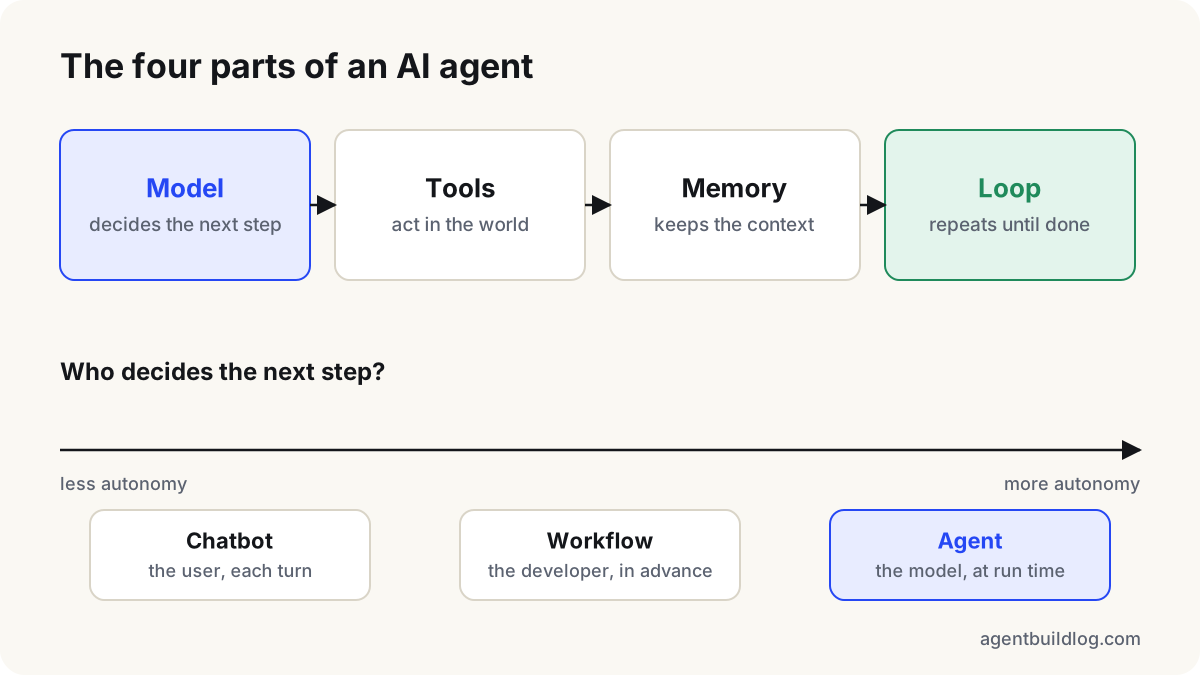
1. The model: the decision-maker. A large language model reads the situation and decides what to do. It doesn't run anything; it produces either an answer or a request like "call the search tool with this query".
2. Tools: the hands. Tools are ordinary functions the agent may ask to use: search the web, query a database, read a file, send a message. The model only sees a name, a description and the arguments each one takes. Your code runs the tool and reports back what happened.
3. Memory: the notebook. At minimum this is the running conversation: the goal, every action taken and every result. Larger systems add long-term memory, such as notes saved between sessions or a searchable store of past work.
4. The loop: the persistence. Decide, act, observe the result, decide again. The loop is what turns a model that talks into a system that does. It's also where things go wrong, which is why good agents have step limits and checkpoints.
Chatbot, workflow or agent?
It helps to see these as points on a scale of autonomy rather than separate species.
| Who decides the next step? | Example | |
|---|---|---|
| Chatbot | The user, every turn | Answering a question about a product |
| Workflow | The developer, in advance | "Summarise each new support ticket, then tag it" |
| Agent | The model, at run time | "Find out why this test fails and propose a fix" |
Workflows are underrated. If you can write the steps down in advance, a workflow is cheaper, faster and far easier to test than an agent. Agents earn their cost when the path can't be known in advance: debugging, research, or tasks where each step depends on what the previous one found.
What agents are good at today
Agents work best when three things are true:
- Results can be checked. Code either passes its tests or it doesn't; a file either exists or it doesn't. Clear feedback lets the loop correct itself.
- Mistakes are cheap or reversible. Drafting, searching and reading are safe. Paying, deleting and emailing customers are not.
- The task is bounded. "Fix this failing test" is a good agent task. "Grow my business" is not.
That's why coding assistants were among the first agents to become genuinely useful: code gives fast, objective feedback, and changes can be reviewed before they're merged.
Where they still struggle
- Long tasks drift. Small errors compound over many steps, and the agent can confidently pursue the wrong goal.
- Cost and speed. Each step is a model call. A task that takes forty steps costs forty calls.
- Security. An agent that reads web pages or emails can meet text written to manipulate it, an attack called prompt injection. Any agent with powerful tools needs limits on what those tools can do, and a human approval step before actions that matter.
How to judge an "agent" product
Ask three questions:
- Does the model choose the steps, or follow a fixed script? Both can be useful, but only one is an agent.
- What tools can it use, and what stops it from misusing them? Look for permissions, approvals and logs.
- How does it know it's done, and what happens when it's stuck? Good answers involve tests, step limits and asking a human.
The bottom line
Strip away the marketing and an agent is a simple idea: a model, some tools, a memory and a loop. The hard part isn't the concept, it's the engineering around it: choosing the right tools, limiting the damage of mistakes, and knowing when a plain workflow would do the job better.
If you'd like to see how small the core really is, our tutorial Build an AI Agent With Function Calling in TypeScript walks through a complete agent loop in about 80 lines.
Weekly briefing
The AI build log, once a week
The news that matters and our newest tutorials. No hype, no spam.
One-click unsubscribe anytime.
More blog
Blog
AI in Production: 7 Mistakes That Make AI Features Fail
The demo worked beautifully. Then real users arrived. These are the seven most common reasons AI features disappoint after launch, and the practical fix for each one.
Blog
RAG vs Fine-Tuning (LoRA) vs Long Context: Which Does Your AI App Need?
Three ways to give a language model knowledge it doesn't have, and they solve different problems. A practical guide to choosing, with a simple decision path you can apply to your own project.