Anthropic Releases Claude Fable 5.2 and Mythos 5.2 for Hard Technical Work
Source: Anthropic
Anthropic's new top-tier models post higher coding, computer-use and research scores than Claude Opus 5.5. Fable 5.2 is available to everyone; Mythos 5.2, with fewer restrictions, is limited to vetted security and life-science organisations.
Anthropic released Claude Fable 5.2 and Claude Mythos 5.2 on November 9, describing them as its most capable models for "the most daunting technical challenges".
The two share the same underlying model but differ in access. Fable 5.2 ships with safeguards for cybersecurity and biology and is available to all users, in Anthropic's apps, its API (model ID claude-fable-5-2) and through Amazon Web Services, Google Cloud and Microsoft Azure. Mythos 5.2 has fewer restrictions and is offered only to vetted organisations through Anthropic's cybersecurity and life-sciences verification programs.
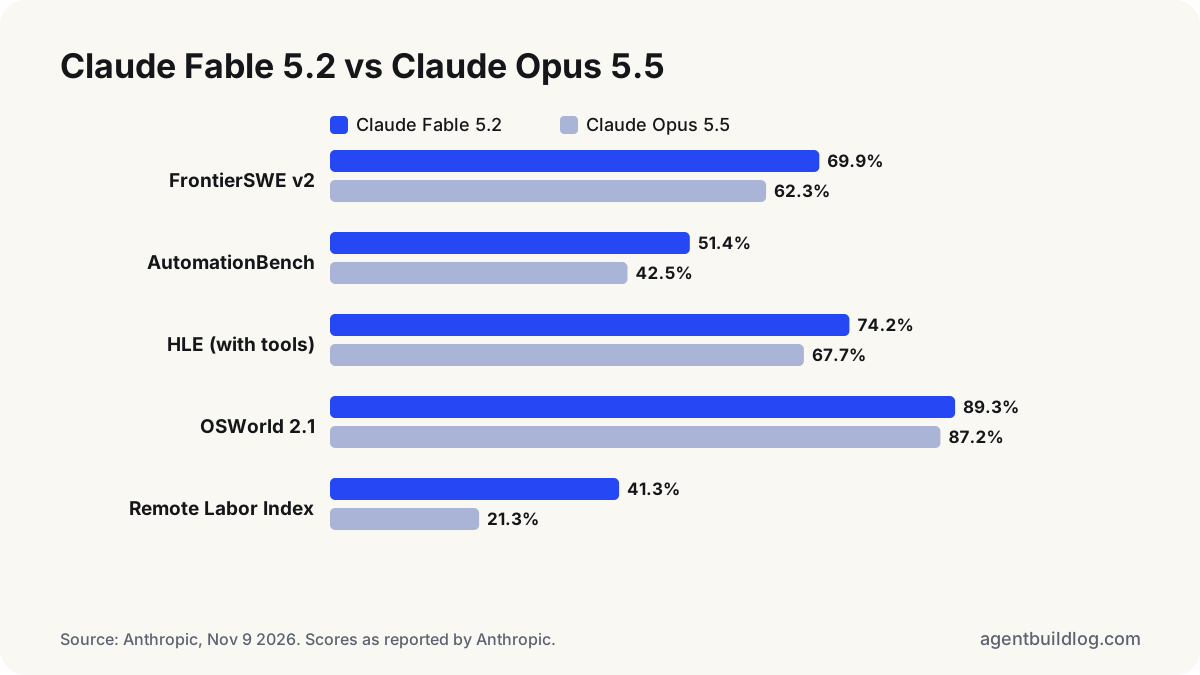
What changed
According to Anthropic, Fable 5.2 beats its everyday model, Claude Opus 5.5, across agentic coding, computer use and research benchmarks. The largest gap is on the Remote Labor Index (41.3% vs 21.3%). The company says outputs are up to 30% faster than the previous 5.1 versions, and an optional fast mode generates tokens up to 2.5 times faster.
Anthropic still recommends Opus 5.5 for most everyday coding and knowledge work, and positions Fable for ambitious, open-ended technical projects.
Pricing
- Standard: $8 per million input tokens and $40 per million output tokens.
- Fast mode: $16 input and $80 output per million tokens.
Safety notes
Anthropic says Fable 5.2's cyber and biology classifiers block about 55% fewer legitimate requests than in the previous version. It also notes that both models more often voice suspicion that they're being tested, which it says makes safety evaluation harder. External testers included the UK AI Security Institute and METR.
Why it matters for builders
The model is aimed at long, autonomous technical tasks rather than chat. If you build agents, it's another option at the top end of capability and price. For most everyday features, a cheaper model that passes your own evaluation set is still the better default.
Read the original at Anthropic →
AI-assisted summary of reporting by Anthropic, reviewed against the original source.
Weekly briefing
The AI build log, once a week
The news that matters and our newest tutorials. No hype, no spam.
One-click unsubscribe anytime.
Keep reading
AI ResearchThinking Machines Lab
Thinking Machines Trains Inkling 2 Small With 4-Bit Math End to End
Thinking Machines Lab says its Inkling 2 Small model ran a native 4-bit forward pass from pretraining through reinforcement learning, cutting RL time by about 20% with no measurable loss in reward.
IndustryMistral AI
Mistral Releases Open Weights for Mistral Large 4, a 1-Trillion-Parameter Model
Mistral has published the weights of its flagship Mistral Large 4, nicknamed "Le Chonk", aimed at agentic coding and defensive cybersecurity. It can be self-hosted, with a separate licence needed for companies selling it as a hosted service.
Blog
AI in Production: 7 Mistakes That Make AI Features Fail
The demo worked beautifully. Then real users arrived. These are the seven most common reasons AI features disappoint after launch, and the practical fix for each one.
Tutorial
Structured Output From LLMs: Get Reliable JSON With Validation and Retries
LLMs return almost-valid JSON surprisingly often. Here's a small, provider-agnostic pattern in TypeScript that turns model output into data you can trust, using JSON mode, Zod validation and a retry with feedback.