Mistral Releases Open Weights for Mistral Large 4, a 1-Trillion-Parameter Model
Source: Mistral AI
Mistral has published the weights of its flagship Mistral Large 4, nicknamed "Le Chonk", aimed at agentic coding and defensive cybersecurity. It can be self-hosted, with a separate licence needed for companies selling it as a hosted service.
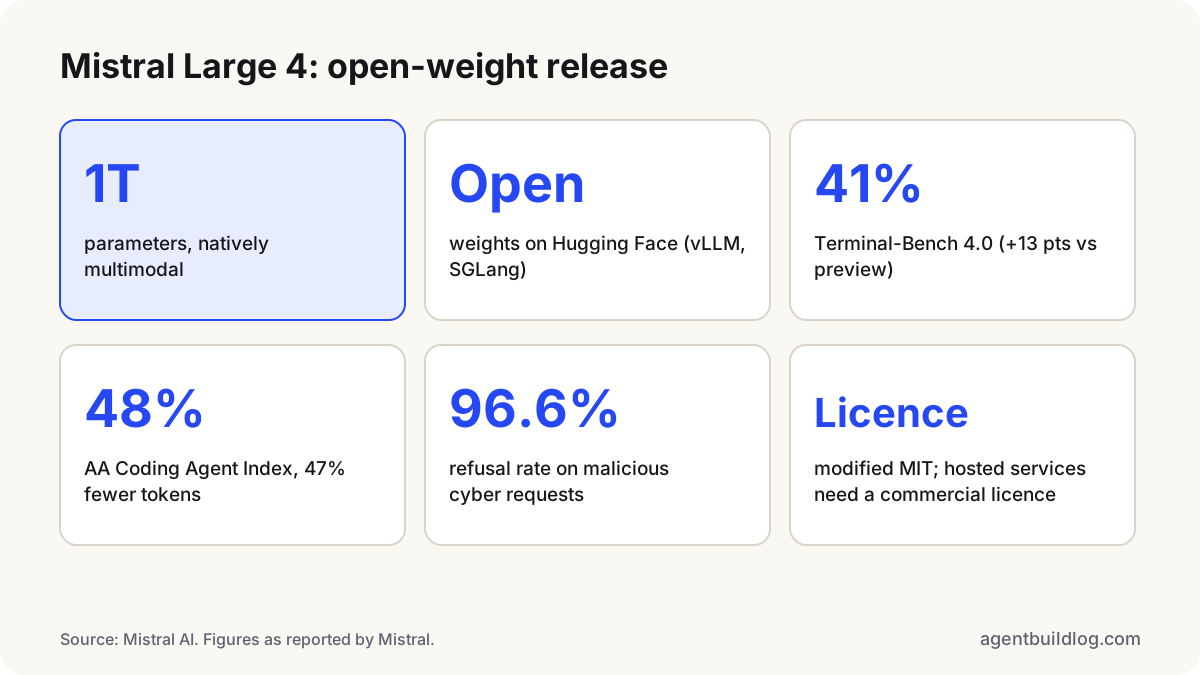
Mistral AI has released the weights of Mistral Large 4, its flagship model, which the company nicknames "Le Chonk". Mistral describes it as a natively multimodal model with 1 trillion parameters, trained from scratch on European infrastructure.
What's in the release
The released version follows a public preview earlier in the month, with what Mistral says is three more weeks of reinforcement learning. The model has three reasoning modes (low, medium and high) and is aimed at two areas: agentic coding and defensive cybersecurity, such as finding, reproducing and patching vulnerabilities.
Weights are on Hugging Face for self-hosting with vLLM or SGLang. The model is also offered through Mistral's API and Studio, OpenRouter, NVIDIA endpoints and Microsoft Foundry.
The licence
Mistral says the model is free to use, modify, fine-tune and use commercially under its "Mistral Ecosystem Open-Weight" licence, which it describes as a modified MIT licence. The main condition: companies offering the model as a hosted service need a separate commercial licence. Check the licence text yourself before building a product on it.
Reported results
- Terminal-Bench 4.0: 41%, which Mistral says is 13 points above the preview.
- Artificial Analysis Coding Agent Index: 48%, roughly level with GLM-5.3 while using 47% fewer tokens per task on average.
- Malicious cyber requests: an average refusal rate of 96.6%, which Mistral calls the highest it has measured among open models.
Mistral also says that, after watching live traffic, it sees "a potential for uplift to conduct real attacks", and is adjusting its guardrails. A more capable cybersecurity variant is limited to vetted partners.
Why it matters for builders
A trillion-parameter open-weight model gives teams that need to keep data in-house another frontier-class option. Running it needs serious GPU capacity; for most teams the hosted API is the realistic way to try it.
Read the original at Mistral AI →
AI-assisted summary of reporting by Mistral AI, reviewed against the original source.
Weekly briefing
The AI build log, once a week
The news that matters and our newest tutorials. No hype, no spam.
One-click unsubscribe anytime.
Keep reading
AI ResearchThinking Machines Lab
Thinking Machines Trains Inkling 2 Small With 4-Bit Math End to End
Thinking Machines Lab says its Inkling 2 Small model ran a native 4-bit forward pass from pretraining through reinforcement learning, cutting RL time by about 20% with no measurable loss in reward.
IndustryAnthropic
Anthropic Releases Claude Fable 5.2 and Mythos 5.2 for Hard Technical Work
Anthropic's new top-tier models post higher coding, computer-use and research scores than Claude Opus 5.5. Fable 5.2 is available to everyone; Mythos 5.2, with fewer restrictions, is limited to vetted security and life-science organisations.
Blog
AI in Production: 7 Mistakes That Make AI Features Fail
The demo worked beautifully. Then real users arrived. These are the seven most common reasons AI features disappoint after launch, and the practical fix for each one.
Tutorial
Structured Output From LLMs: Get Reliable JSON With Validation and Retries
LLMs return almost-valid JSON surprisingly often. Here's a small, provider-agnostic pattern in TypeScript that turns model output into data you can trust, using JSON mode, Zod validation and a retry with feedback.