Thinking Machines Trains Inkling 2 Small With 4-Bit Math End to End
Source: Thinking Machines Lab
Thinking Machines Lab says its Inkling 2 Small model ran a native 4-bit forward pass from pretraining through reinforcement learning, cutting RL time by about 20% with no measurable loss in reward.
Thinking Machines Lab has published details of how it trained Inkling 2 Small using very low-precision numbers. The lab calls it the largest model it knows of trained "end-to-end with a native 4-bit forward pass".
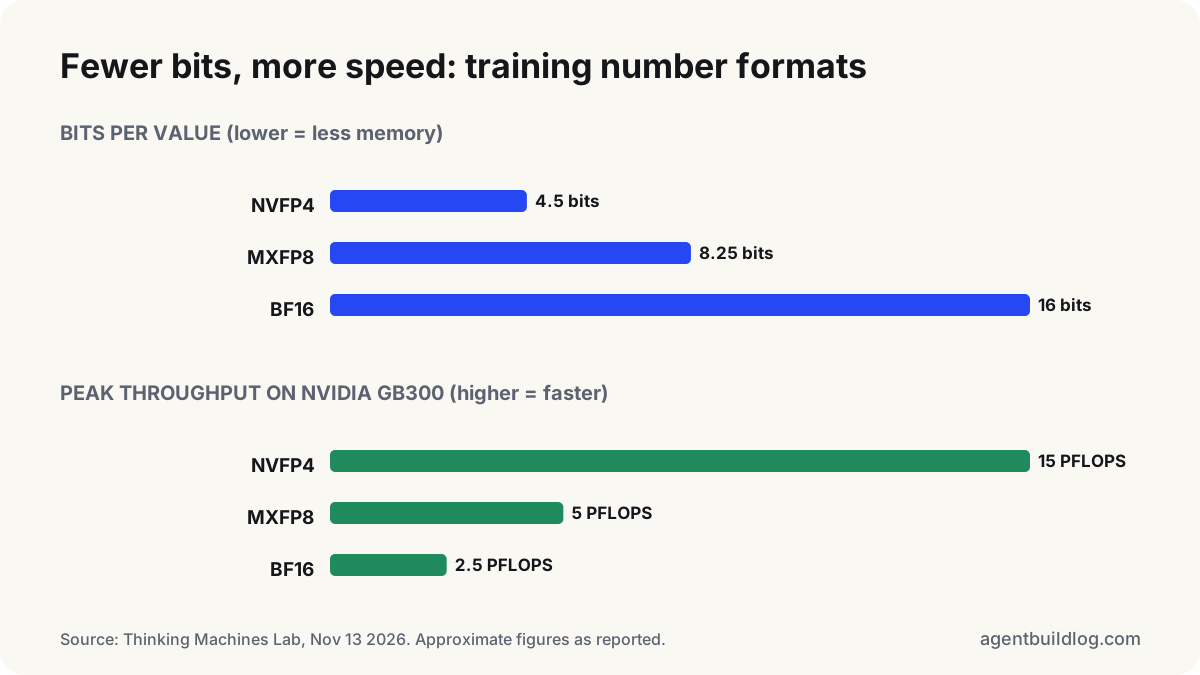
What "4-bit training" means here
Neural networks are trained with numbers stored at some precision. Fewer bits per number means less memory and faster maths, at the risk of less accurate training.
Thinking Machines used NVIDIA's NVFP4 format (about 4.5 bits per value) for the forward pass of the model's mixture-of-experts layers. It kept the backward pass, where gradients are computed, in the 8-bit MXFP8 format. The same setup ran from pretraining through the final reinforcement-learning stage.
Reported results
- Pretraining cost about 2% in compute efficiency compared with full 8-bit training, while running about 8% faster in wall-clock time on the lab's largest jobs.
- Reinforcement learning ran about 20% faster, with "no discernible difference in reward".
- Pretraining Inkling 2 Small took 68 hours on NVIDIA GB300 NVL72 racks. The lab says a similar-sized model previously took several weeks.
- Running the backward pass in 4-bit as well caused "very large hits" to efficiency, so the team didn't use it.
The kernels were developed in-house. The post doesn't say whether code or recipes will be released.
Why it matters for builders
Cheaper, faster training tends to show up later as cheaper and faster models. Low-precision formats are also how many open models are served today. This result suggests 4-bit numbers can be used much earlier in a model's life than many teams assumed.
Read the original at Thinking Machines Lab →
AI-assisted summary of reporting by Thinking Machines Lab, reviewed against the original source.
Weekly briefing
The AI build log, once a week
The news that matters and our newest tutorials. No hype, no spam.
One-click unsubscribe anytime.
Keep reading
IndustryAnthropic
Anthropic Releases Claude Fable 5.2 and Mythos 5.2 for Hard Technical Work
Anthropic's new top-tier models post higher coding, computer-use and research scores than Claude Opus 5.5. Fable 5.2 is available to everyone; Mythos 5.2, with fewer restrictions, is limited to vetted security and life-science organisations.
IndustryMistral AI
Mistral Releases Open Weights for Mistral Large 4, a 1-Trillion-Parameter Model
Mistral has published the weights of its flagship Mistral Large 4, nicknamed "Le Chonk", aimed at agentic coding and defensive cybersecurity. It can be self-hosted, with a separate licence needed for companies selling it as a hosted service.
Blog
AI in Production: 7 Mistakes That Make AI Features Fail
The demo worked beautifully. Then real users arrived. These are the seven most common reasons AI features disappoint after launch, and the practical fix for each one.
Tutorial
Structured Output From LLMs: Get Reliable JSON With Validation and Retries
LLMs return almost-valid JSON surprisingly often. Here's a small, provider-agnostic pattern in TypeScript that turns model output into data you can trust, using JSON mode, Zod validation and a retry with feedback.